
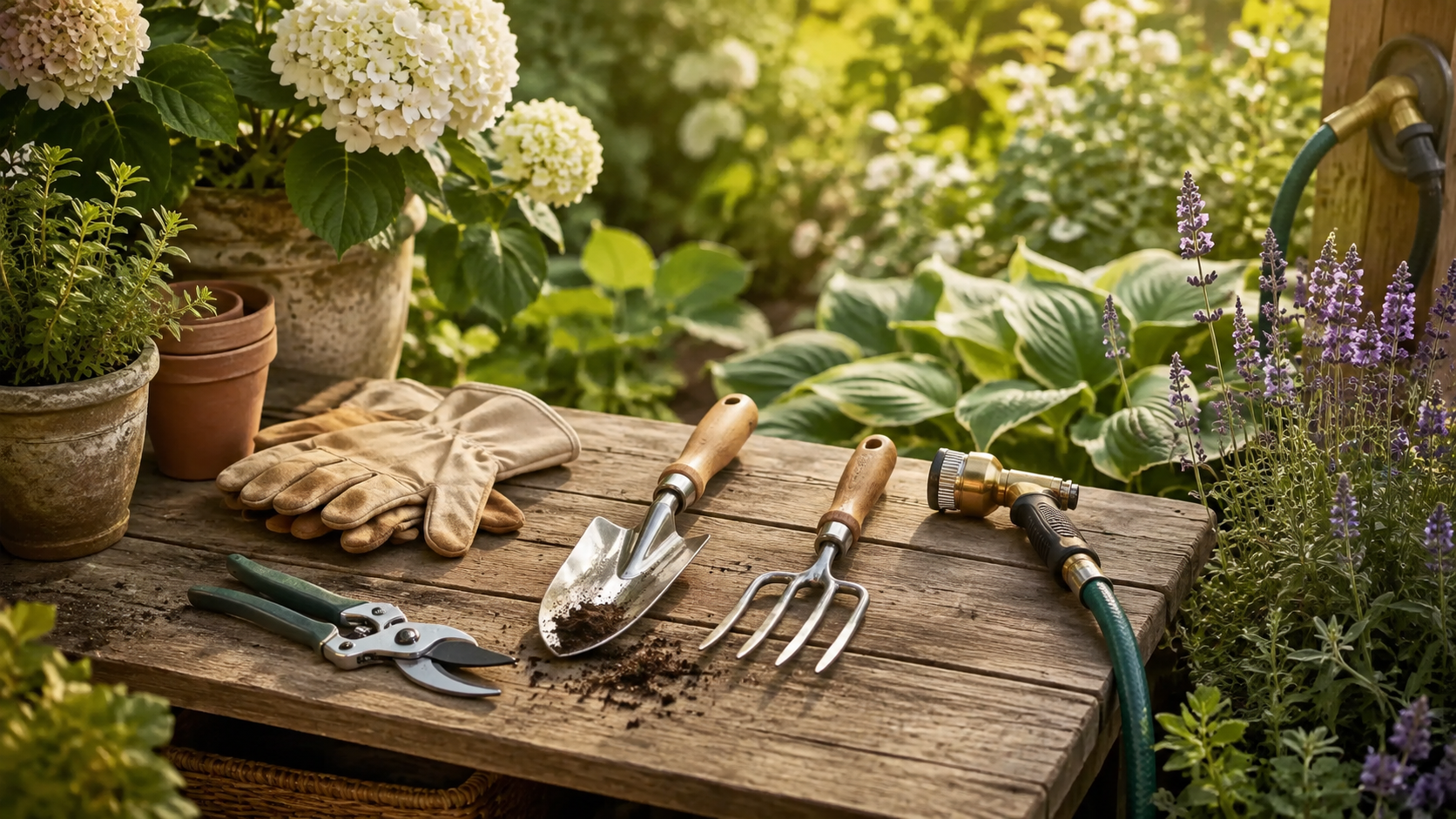
Gardening has a way of accumulating tools.
A trowel here. A new nozzle there. Three pairs of gloves that somehow never seem to be where you left them.
But you really don’t need a shed full of equipment to maintain a beautiful garden. For most home gardeners, a small collection of well-chosen tools will handle nearly everything that comes up.
And while there are plenty of garden products where the inexpensive version works perfectly well, there are a few tools where quality really does make a difference.
The best ones aren’t necessarily the fanciest. They’re the tools that feel good in your hand, do the job without fighting you, and keep working year after year.
Here are the garden tools we think are worth buying carefully — and occasionally spending a little more on.
1. A Good Pair of Bypass Pruners
If you grow shrubs, perennials, roses or small trees, your hand pruners will probably become one of your most-used garden tools.
For live plant material, look for bypass pruners. Their two blades pass alongside one another like scissors, creating a cleaner cut than an anvil-style pruner.
A good pair should:
- feel comfortable in your hand
- open and close smoothly
- have a blade that can be sharpened
- have replacement parts available
- cut cleanly without crushing stems
A buy-it-for-years option: FELCO 2
The FELCO 2 Classic Hand Pruner is one of those garden tools that has remained popular for decades for a reason.
It has replaceable parts, forged aluminum handles and a hardened steel blade, so it can be maintained rather than thrown away when something wears out.
It is best suited to larger hands and right-handed gardeners, so it won’t be the perfect fit for everyone. But for someone who prunes frequently, this is the kind of tool that can stay in the garden shed for many years.
A more affordable everyday option: Corona ClassicCUT
The Corona ClassicCUT bypass pruners are a very practical alternative.
Corona makes different sizes, which matters more than people realize. A pruner that is too large for your hand becomes tiring surprisingly quickly.
Their larger BP 3180D model handles branches up to about an inch, while the smaller BP 3160 is easier for smaller and medium-size hands.
Worth spending more? Yes — particularly if you prune regularly.
2. Loppers That Give You More Leverage
There comes a point when a branch is simply too large for hand pruners.
That is when you want loppers — not stronger hands and more determination.
Trying to force a thick branch through a small pruner can damage the tool, the plant and occasionally your hand.
Long-handled loppers give you substantially more leverage while still creating a clean cut.
What we like: Fiskars PowerGear2 Lopper
The Fiskars PowerGear2 32-inch Lopper is designed to multiply the force you apply to the handles, making larger branches easier to cut.
Its bypass blade handles live wood, and the longer handles give you leverage without requiring as much strength.
For most home gardens, a pair of good loppers fills the gap between hand pruners and a pruning saw nicely.
Worth spending more? Usually. You don’t need the most expensive pair available, but flimsy loppers are frustrating very quickly.
3. A Folding Pruning Saw
Once a branch gets beyond what your loppers comfortably handle, stop trying to muscle through it.
Use a pruning saw.
A folding saw takes up very little space and is incredibly useful for:
- small tree limbs
- mature shrubs
- damaged branches
- awkward woody stems
What we like: Silky GOMBOY
The Silky GOMBOY folding saw is a compact pruning saw with an excellent reputation for smooth cutting.
It folds closed for storage and handles branches that would be miserable to tackle with loppers.
It costs more than a basic pruning saw, but this is another category where a sharp, well-made tool makes the job noticeably easier.
One caution: these saws are extremely sharp. Let the blade do the work rather than forcing it.
Worth spending more? If you have mature trees and shrubs, yes.
4. A Garden Hose That Doesn’t Make You Angry
A garden hose sounds like the least glamorous purchase imaginable — until you spend an entire summer fighting one that twists, kinks and refuses to lie flat.
For a hose you use frequently, look for:
- flexibility
- durable fittings
- kink resistance
- manageable weight
- the right length for your property
Longer is not automatically better. A 100-foot hose is wonderful when you need 100 feet and unnecessarily cumbersome when you need 35.
What we like: Flexzilla SwivelGrip
The Flexzilla SwivelGrip garden hose uses a flexible hybrid material that remains easier to maneuver than many traditional hoses.
The swivel fittings are particularly useful because they allow the hose to rotate rather than twisting every time you move around a bed.
It is bright green — subtle it is not — but functionally, it checks a lot of boxes.
Worth spending more? Yes, if you hand-water frequently.
5. A Gentle Watering Wand
A high-pressure blast from a hose nozzle isn’t the best way to water most plants.
A watering wand allows you to reach beneath foliage and direct water closer to the root zone while producing a softer shower.
They’re particularly useful for:
- containers
- newly planted beds
- annuals
- perennials
- seedlings
- plants with dense foliage
What we like: Dramm One Touch Rain Wand
The Dramm One Touch Rain Wand has a long reach and a gentle shower head.
The thumb-controlled valve also lets you turn the water on and off without repeatedly squeezing a trigger.
For gardeners with lots of containers or layered flower beds, a watering wand is one of those tools you don’t realize you need until you’ve used one.
Worth spending more? A little. You don’t need a luxury watering wand, but sturdy construction and a comfortable valve are worth paying for.
6. A Simple Hand Trowel
Here’s one place where you do not need to spend a fortune.
A hand trowel is useful for:
- planting annuals
- moving small perennials
- digging small holes
- loosening soil
- mixing amendments into small areas
What matters most is a solid head and a handle that doesn’t hurt your hand.
What we like: Fiskars Ergo Trowel
The Fiskars Ergo Trowel is inexpensive, comfortable and made with a cast-aluminum head that resists rust.
This is exactly the kind of tool where simple is often better.
Worth spending more? Not really.
Save your garden-tool budget for the things with blades, moving parts or hoses.
7. Gloves That Match the Job
There isn’t one perfect garden glove.
The best approach is actually having two or three different kinds.
For planting and weeding
A lightweight, breathable glove gives you much better dexterity for pulling weeds, potting plants and working around delicate stems.
Bamboo-style garden gloves are especially comfortable in warm weather.
For hauling and digging
When you’re moving stone, mulch, branches or rough materials, switch to a heavier leather or reinforced glove.
The Wells Lamont HydraHyde style is a good example of a tougher glove designed for wet and abrasive work.
For roses and thorny shrubs
Use a long gauntlet glove.
Ordinary gardening gloves leave your wrists and forearms exposed, which you’ll immediately regret while reaching into the middle of a rose bush.
Worth spending more? Sometimes.
More important than price is owning the right glove for the job.
Where We Would Spend — and Where We Would Save
If we were putting together a garden tool kit from scratch, we’d spend more on:
Pruners, loppers, pruning saws and a frequently used garden hose.
Those tools take repeated abuse, and better construction noticeably affects how well they work.
We’d spend less on:
Trowels, small hand cultivators, buckets and basic planting accessories.
Simple tools don’t always need premium engineering.
And before buying anything, consider how often you’ll actually use it.
The best garden tool isn’t the one with the longest feature list. It’s the one that makes a regular garden chore easier.
Start With the Garden You Actually Have
You don’t need to buy all of these at once.
A gardener with young flower beds may use little more than pruners, a trowel, gloves and a watering wand.
Someone caring for mature shrubs and small trees will get much more use from loppers and a pruning saw.
Build your tool collection as your garden gives you a reason to.
That’s a much better approach than filling a shed with tools you thought gardeners were supposed to own.
And when you find a tool that works particularly well?
Clean it, sharpen it when necessary, put it back where it belongs — and keep it for years.
Leave a Reply