
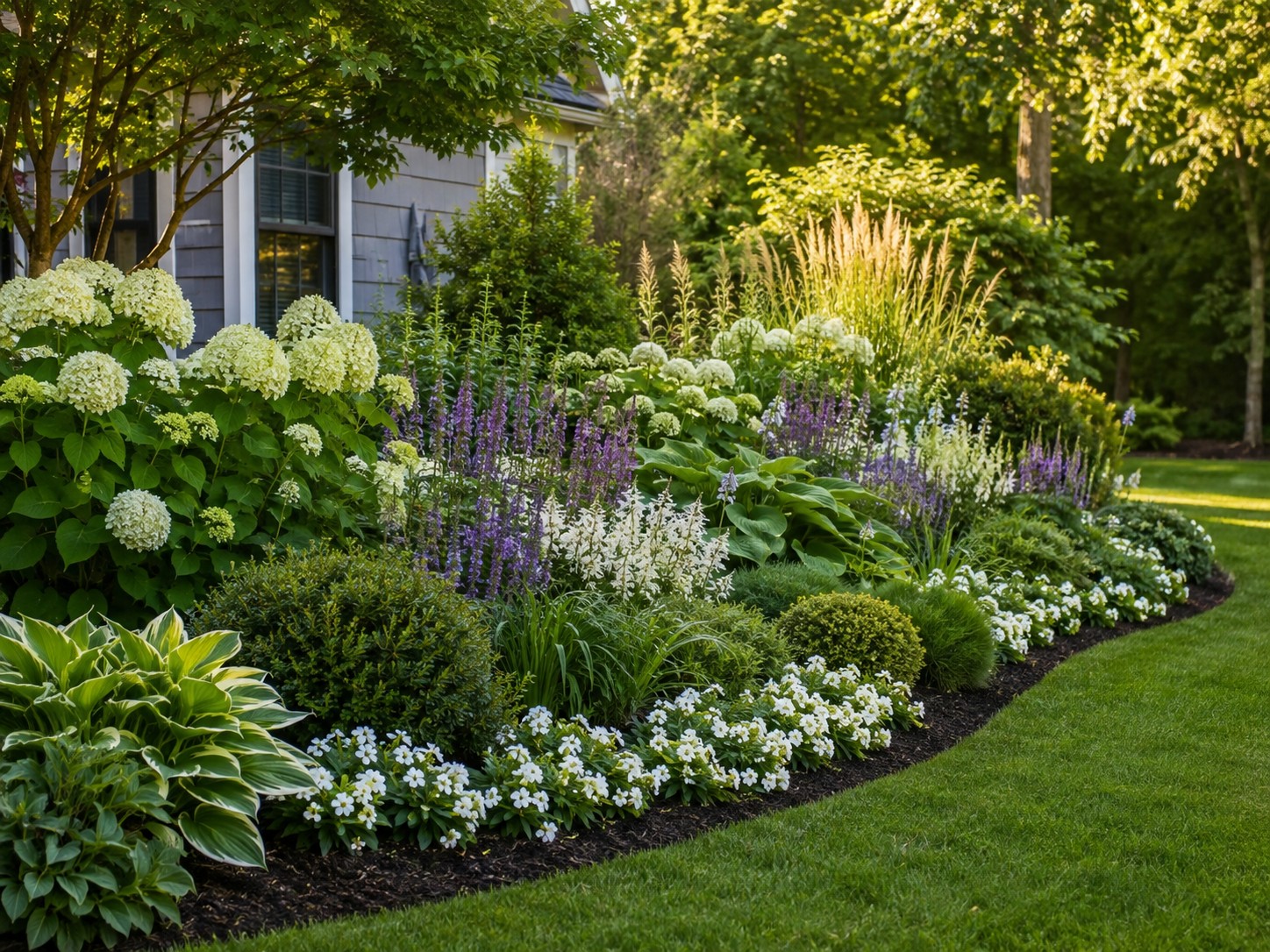
A garden bed feels finished when the plants look like they belong together—not like a row of individual things spaced across the mulch.
The secret is layering. That means combining plants with different heights, shapes, textures, and bloom times so the bed has structure from front to back and interest through the seasons.
You do not need dozens of different plants to get the look. In fact, the best beds often use fewer varieties and repeat them well.
Start With the Shape of the Bed
Before choosing plants, look at the bed itself.
Consider:
- How deep the bed is
- Whether it is straight or curved
- Where it is viewed from
- Whether there is a wall, fence, or open lawn behind it
- Where the tallest plants can go without blocking windows or walkways
A deep bed gives you more room to create layers. A narrow bed may need fewer height changes and a simpler plant palette.
Think in Three Basic Layers
A simple way to plan a garden bed is to divide the planting into three general heights.
Back Layer
The back layer provides height and structure.
This may include:
- Small trees
- Tall shrubs
- Large ornamental grasses
- Taller flowering perennials
These plants help anchor the bed and keep it from looking flat.
If the bed can be viewed from all sides, place taller plants toward the center instead of the back.
Middle Layer
The middle layer creates fullness.
This is often where medium-height shrubs and perennials do the most work.
Look for plants with substantial foliage and enough width to visually connect the taller plants behind them with the lower plants in front.
This layer is especially important because it prevents the bed from looking empty between large anchor plants and small edging plants.
Front Layer
The front layer softens the edge of the garden bed.
Use:
- Low-growing perennials
- Groundcovers
- Compact grasses
- Small flowering plants
- Plants that naturally spill or spread slightly toward the edge
Avoid lining the front with tiny individual plants spaced far apart. Groups usually look more natural and established.
Repeat Plants Instead of Using One of Everything
One of the easiest ways to make a garden look more polished is to repeat plants.
Instead of planting:
one salvia + one coneflower + one daylily + one ornamental grass + one daisy
try repeating a few plants in groups throughout the bed.
Repetition gives the eye somewhere to rest and helps the planting feel intentional.
Odd-numbered groupings such as three, five, or seven plants often work well, but the exact number matters less than creating a visible mass.
Plant in Drifts and Groups
Plants rarely look their best when they are placed like dots on a page.
Group the same variety together or allow several plants to form a loose drift.
A drift does not have to be perfectly symmetrical. In fact, a slightly irregular shape often looks more natural.
Think of creating broad areas of foliage and color rather than individual specimens.
Mix Foliage Shapes and Textures
Flowers are temporary. Foliage is what you will see most of the year.
Combine different leaf shapes and textures to keep the garden interesting even when nothing is blooming.
For example:
- Broad leaves beside fine grasses
- Glossy foliage beside soft or fuzzy leaves
- Upright plants beside rounded mounds
- Fern-like foliage beside large simple leaves
Contrast makes each plant easier to see.
Use Color With Restraint
A full garden does not need every color.
Choose a loose color palette and repeat it throughout the bed.
You might combine:
- White, soft pink, and green
- Purple, blue, and white
- Yellow, lavender, and green
- Warm pink, coral, and cream
Foliage color counts too. Deep green, silver, chartreuse, blue-green, and burgundy leaves can add as much interest as flowers.
Plan for Different Bloom Times
If every plant blooms in May, the garden may feel empty by July.
Try to include plants that peak at different times.
A layered garden might include:
- Spring bulbs and flowering shrubs
- Early-summer perennials
- Heat-loving summer bloomers
- Late-summer grasses and flowers
- Fall foliage and seedheads
- Evergreen structure for winter
The goal is not constant flowers everywhere. It is to make sure something interesting is always happening.
Leave Room for Plants to Grow
A newly planted garden bed often looks too empty.
That is normal.
Plants need room to reach their mature size. If you pack them tightly just to make the bed look full immediately, you may end up with overcrowding, poor airflow, and constant pruning later.
Use mature width—not the size of the plant in the nursery pot—to determine spacing.
You can temporarily fill gaps with annuals or mulch while permanent plants establish.
Do Not Forget Structure
Flowering perennials alone can sometimes make a bed feel busy or disappear completely in winter.
Add a few plants that provide reliable structure.
This might include:
- Evergreen shrubs
- Small ornamental trees
- Boxwood or similar rounded forms
- Upright grasses
- Architectural foliage plants
These anchors help hold the design together while other plants come and go.
Soften the Edges
A bed often looks more established when a few plants gently touch or overlap the edge.
Avoid creating a hard line where every plant stops several inches before the border.
Low-growing plants that spill slightly toward a path, lawn, or stone edge help connect the garden to the surrounding space.
Just make sure they do not interfere with walking areas.
Step Back and Look at the Whole Bed
Do not judge the design one plant at a time.
Stand back and look for:
- Repeated shapes
- Balanced height
- Areas that feel too empty
- Areas that feel too busy
- Color repeated across the bed
- Enough evergreen or structural planting
- Clear layers from low to tall
Sometimes moving one group of plants or repeating a variety in another part of the bed makes a bigger difference than adding something new.
A Simple Formula to Start With
If you are unsure where to begin, try this basic approach:
- 1–3 anchor plants for height and structure
- 2–3 repeating medium-height plants for fullness
- 1–2 lower plants repeated along the front
- A few seasonal plants for changing color or bloom
Then repeat those plants rather than continually adding new varieties.
The result is usually a garden that feels fuller, calmer, and more intentional.
A beautiful layered garden is not about fitting in the most plants possible. It is about choosing plants that work together and giving each one a clear role in the composition.
Leave a Reply