
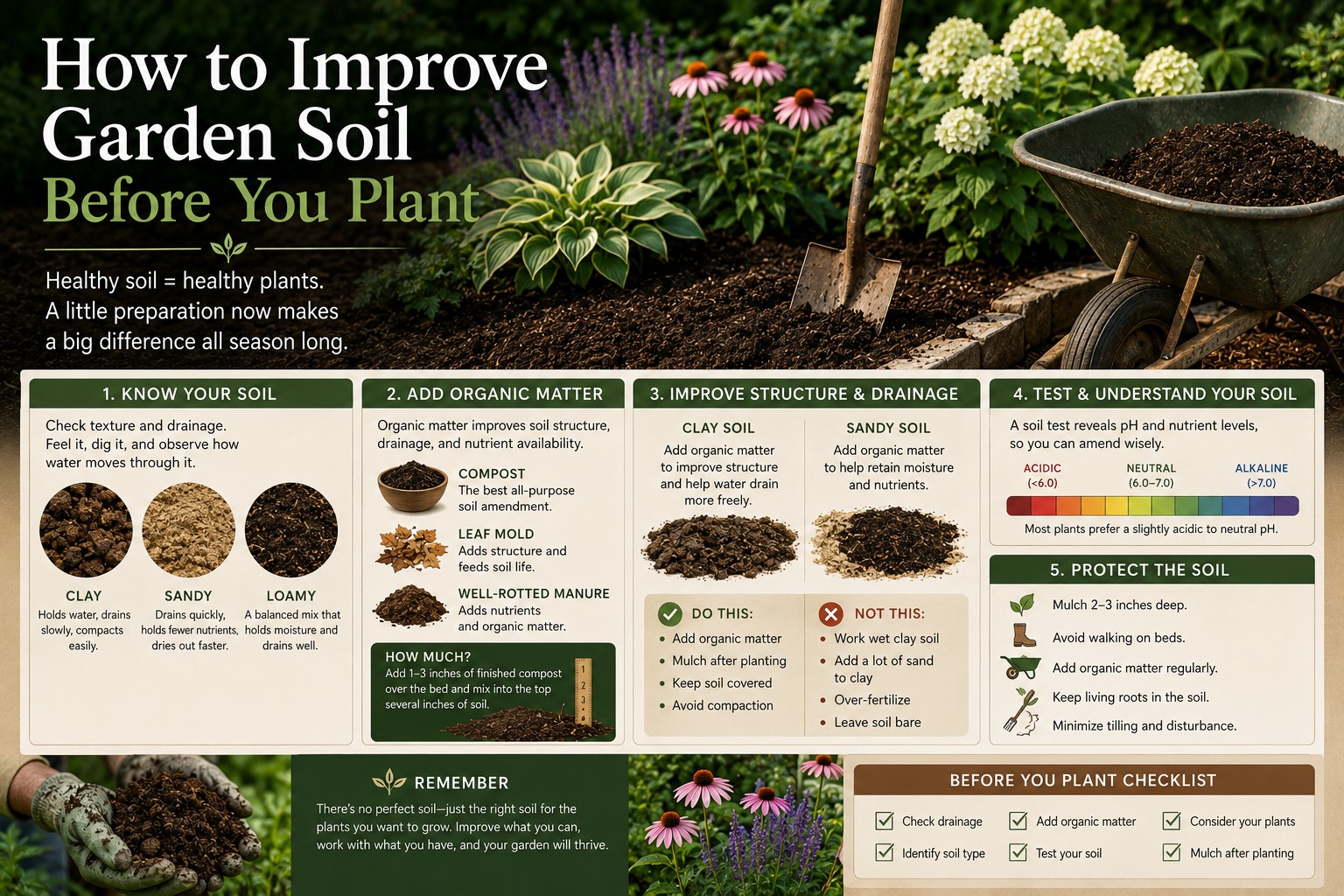
Healthy plants start with healthy soil.
You can buy beautiful plants, water carefully, and choose the right amount of sun, but if the soil drains poorly, compacts easily, or lacks organic matter, plants may still struggle.
The good news is that most garden soil can be improved. The key is understanding what you are working with before adding amendments.
Start by Looking at Your Soil
Before adding anything, dig into the bed and notice how the soil behaves.
Ask yourself:
- Does it feel heavy and sticky?
- Does it fall apart easily?
- Does water drain quickly or sit on the surface?
- Does the soil dry out almost immediately?
- Is it difficult to dig?
- Are there many roots, rocks, or construction debris?
You do not need a laboratory test to notice basic texture and drainage problems.
Check the Drainage
Poor drainage is one of the most common reasons plants fail.
After a heavy rain, notice how long water remains in the area.
If water disappears fairly quickly, drainage is probably adequate.
If puddles remain for many hours or the soil stays saturated for days, you may need to improve drainage or choose plants that tolerate wetter conditions.
Before trying to completely change the soil, remember that choosing plants suited to your existing conditions is often the easiest long-term solution.
Know the Difference Between Clay, Sandy, and Loamy Soil
Clay Soil
Clay contains very small soil particles.
It tends to:
- Hold water well
- Drain slowly
- Become sticky when wet
- Become hard when dry
- Compact easily
Clay soil can actually contain plenty of nutrients. The biggest challenge is usually improving its structure and drainage.
Sandy Soil
Sandy soil contains larger particles and drains quickly.
It tends to:
- Dry out faster
- Hold fewer nutrients
- Feel loose or gritty
- Be easier to dig
Sandy soil often benefits from organic matter that helps it retain moisture and nutrients.
Loamy Soil
Loam contains a more balanced mixture of sand, silt, clay, and organic matter.
It generally:
- Holds moisture without staying soggy
- Drains well
- Crumbles easily
- Supports healthy root growth
Most gardeners are trying to move their soil closer to this kind of structure.
Add Organic Matter
For many gardens, the single most useful soil improvement is organic matter.
Good options include:
- Finished compost
- Leaf mold
- Well-rotted manure
- Composted bark
- Other fully decomposed organic materials
Organic matter can help improve both clay and sandy soils.
In clay, it helps create better structure and air spaces.
In sandy soil, it helps increase moisture and nutrient retention.
How Much Compost Should You Add?
If you are preparing a new garden bed, adding roughly 1 to 3 inches of finished compost over the soil surface is a useful starting point.
Mix it into the upper several inches of soil when preparing a new bed.
Once the garden is established, you can often maintain the soil by adding a lighter layer of compost to the surface periodically and allowing soil organisms to work it in naturally.
Avoid assuming that more compost is always better. Soil still needs mineral content, drainage, and structure.
Do Not Work Wet Clay Soil
If you have heavy clay soil, avoid digging or tilling it when it is very wet.
Working wet clay can destroy its structure and create dense clumps that become extremely hard when they dry.
A simple test is to squeeze a handful of soil.
If it forms a slick, sticky ball that smears easily, wait.
If it crumbles when gently pressed, conditions are better for working the bed.
Be Careful With Sand in Clay Soil
Adding a little sand to heavy clay usually does not fix the problem.
In some cases, an improper ratio of sand and clay can create an even denser mixture.
Organic matter is usually a more practical amendment for improving heavy garden soil.
If drainage is severe, consider raised planting areas, grading changes, drainage solutions, or plants adapted to those conditions.
Test Your Soil When It Matters
A soil test can tell you more than appearance alone.
Depending on the test, you may learn about:
- Soil pH
- Phosphorus
- Potassium
- Nutrient deficiencies
- Organic matter
- Other soil characteristics
This is especially useful before adding fertilizers or products intended to change soil pH.
Avoid adding lime, sulfur, or large amounts of fertilizer simply because someone told you gardens “need” them.
Test first.
Understand Soil pH
Soil pH affects how easily plants can access nutrients.
Some plants prefer acidic soil, while others tolerate or prefer more alkaline conditions.
Rather than trying to drastically change the pH of an entire garden, it is often easier to choose plants naturally suited to your soil.
If you do need to adjust pH, use a soil test and follow recommendations carefully.
Avoid Over-Amending Individual Planting Holes
It can be tempting to fill a planting hole with rich compost and amendments.
But creating a pocket of completely different soil can sometimes discourage roots from growing into the surrounding native soil.
For trees and shrubs especially, it is usually better to focus on improving the broader planting area rather than creating a tiny pocket of perfect soil.
Protect the Soil After Planting
Soil improvement does not end when the plants go in.
After planting:
- Add an appropriate layer of mulch
- Avoid walking on planting areas
- Keep heavy equipment off garden beds
- Add organic matter periodically
- Avoid unnecessary tilling
- Keep living roots in the soil when practical
Healthy soil develops over time.
Do Not Chase Perfect Soil
There is no single perfect garden soil.
Different plants naturally prefer different conditions.
Some thrive in lean, dry soil.
Others prefer rich, moisture-retentive ground.
Some tolerate heavy clay surprisingly well.
The goal is not to turn every garden bed into identical dark, fluffy soil.
The goal is to understand what you have, improve obvious problems, and choose plants that are likely to thrive there.
Before You Plant
Use this simple checklist:
- Check how well the area drains
- Identify whether the soil is primarily clay, sandy, or somewhere in between
- Add organic matter if needed
- Avoid working saturated soil
- Test the soil before making major pH or fertilizer changes
- Consider the needs of the plants you plan to grow
- Mulch after planting to protect the soil surface
Good soil does not happen overnight.
But improving its structure, protecting it from compaction, and adding organic matter over time can make gardening noticeably easier—and give your plants a much better place to grow.
Leave a Reply